


back to blog

The B2B ERP Integration Playbook: How to Escape Ecommerce Lock-in

Read Time 33 mins | Jun 16, 2026 11:30:00 AM

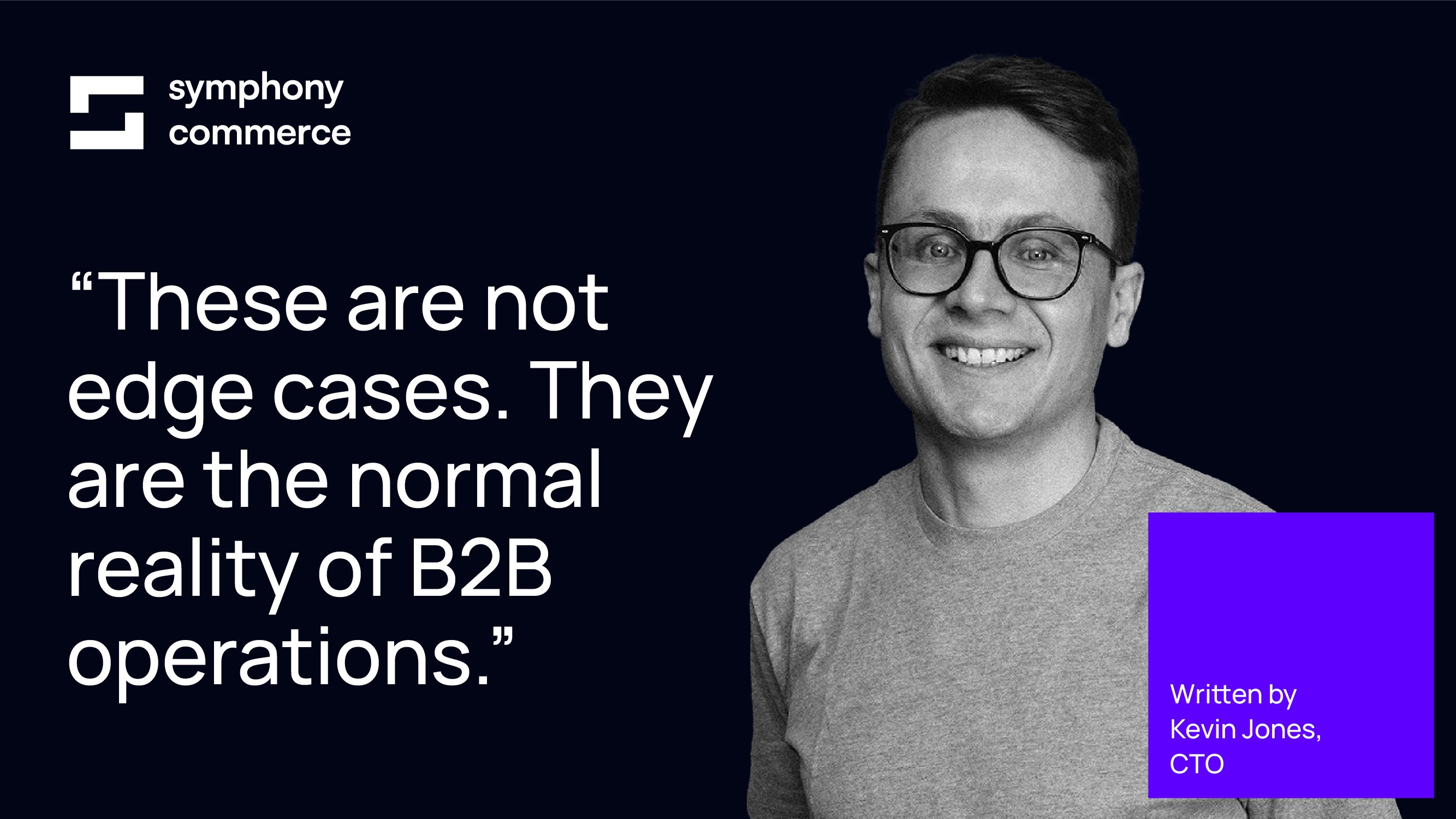
Black and white headshot of Kevin Jones, with a dark background and white quote pulled.

The real problem is not ERP compatibility

A lot of ecommerce providers talk about integrations as if they are a simple compatibility question.
 
“Do you integrate with Sage?”
“Do you integrate with NetSuite?”
“Do you integrate with Microsoft Dynamics?”
 
Those are useful questions, but they are not enough.
 
The better question is:
“Can you support the way our business actually uses its ERP?”
That distinction matters.
 
Two companies can both run Sage 200 and use it in completely different ways. One may need customer-specific price lists, live credit control and multi-warehouse availability. Another may need contract pricing, approval workflows and branch-level ordering. A third may still depend on spreadsheet adjustments outside the ERP because the internal process has evolved over time.
 
The logo on the ERP is only the start.
 
The real integration challenge is understanding the operational model around it.
 
Who owns product data? Where does pricing really come from? How accurate is stock? What happens when an order is rejected? Which system is the source of truth? Which processes are documented, and which live inside someone’s head?
 
These are the questions that decide whether ecommerce integration works.

Native connectors are useful, but they are not a strategy

Native ERP connectors can be helpful. If your business operates in a standard way, a pre-built connector may handle common flows such as product data, stock, customers and orders. For simpler implementations, that can be enough.
 
But many B2B businesses are not simple.
 
They have negotiated pricing, customer-specific catalogues, unusual units of measure, technical product data, approval rules, back-order logic, credit limits, multiple warehouses and long-standing operational exceptions.
 
That is where rigid connectors start to struggle.
 
At the other extreme, some businesses end up with fully bespoke integrations that only one developer understands. They may work for a while, but they become difficult to change, difficult to monitor and risky to migrate away from.
 
The best approach usually sits between those two extremes.
 
You need repeatable integration patterns, but enough flexibility to support how the business really operates.
 
That is why Symphony Commerce has spent the last decade iterating on its own specialist B2B-focused iPaaS, called Conductor.
Conductor is our low-code, block-based integration layer. It allows us to build, adapt and manage custom integrations more quickly and reliably than treating every project as a blank sheet of paper.
 
It gives us a structured way to connect systems, transform data, handle exceptions, monitor jobs and evolve integrations as the business changes.
 
That last point is important.
 
A good ERP integration is not just something that works on launch day. It has to survive new products, new price rules, new warehouses, new customer structures, ERP changes and business growth.

Not sure if your ERP is really the blocker?

You're not alone — and the answer might surprise you.

Real-time is not always the gold standard

One of the most common traps in ERP-connected ecommerce is assuming that “real-time” always means better.
 
It sounds attractive.
 
A customer opens a product page. The website asks the ERP for the latest stock. The customer adds to basket. The website asks the ERP for pricing. The customer checks out. The website asks the ERP again.
 
In theory, everything is live.
 
In practice, the website is now dependent on an internal system that may not have been designed to serve high-volume web traffic.
 
That creates obvious problems.
 
Product pages slow down. Basket calculations lag. Checkout becomes fragile. Search and category pages suffer. Internal systems receive unnecessary traffic. If the ERP is slow, the customer experience is slow.
 
This is especially risky with on-premise ERPs.
 
Many B2B companies still run critical operational systems inside their own infrastructure. Those systems may be stable and well understood, but they are not always built to support constant ecommerce lookups from customers, sales reps and automated services.
Symphony’s approach is different.
Where appropriate, we use high-performance delta syncing.
 
Instead of repeatedly asking the ERP for everything, we synchronise what has changed: products, stock, pricing, customer records, order statuses, invoices and other key data.
 
That gives the website fast access to up-to-date information without forcing every customer interaction to wait for the ERP.
 
This distinction matters:
 
Customers need a real-time experience. That does not always require real-time ERP dependency.
 
A well-designed integration gives buyers current, accurate data while protecting website performance and reducing load on internal systems.
 
That is the difference between an ecommerce platform connected to the ERP and an ecommerce platform slowed down by the ERP.

Case Study

How Mills Ltd Replaced Magento with a Scalable, Multi-Portal Ecommerce Ecosystem

Introduction: Modernising Ecommerce for a Complex B2B Operation

Mills Ltd, the largest independently owned, family-run supplier of specialist tooling and infrastructure products for the telecommunications and renewables sectors, migrated from Magento to Symphony Commerce in 2026 after outgrowing their existing ecommerce setup.

Case Study

The Rapid Rollout of Liberty Workwear’s B2B Ecommerce Portal

Introduction: From Manual Processes to Scalable B2B Success

Liberty Workwear, a trusted supplier of PPE and branded workwear, needed a digital solution that could support the rapid expansion of their B2B customer base.

Case Study

Why Good Hand Switched to Symphony Commerce

Introduction: Replacing a Decade of Digital Stagnation

Good Hand, a specialist B2B engineering manufacturer and distributor, had relied on their previous provider ecommerce platform for over 11 years. During that time, their business evolved - but their digital tools didn’t.

Case Study

JJ O'Toole's Seamless Migration to Symphony Commerce

JJ O’Toole is Ireland’s leading purveyor of bespoke packaging, boasting a prestigious 100-year history of serving the retail and industrial sectors. With a reputation built on quality and heritage, the brand required a digital transformation that could match its physical excellence.

What should actually be integrated?

The goal is not to integrate everything for the sake of it. The goal is to remove friction from the buying journey and reduce manual work inside the business.
 
For most B2B companies, the critical flows are:
  • Product data
  • Stock availability
  • Customer-specific pricing
  • Customer accounts
  • Order creation
  • Order status
  • Invoices and credit notes
  • Order history
  • Account permissions
  • Delivery and fulfilment rules

The exact shape depends on the business.

A distributor may care most about stock by warehouse. A manufacturer may need complex product relationships and technical data. A trade supplier may need contract pricing and repeat ordering. A finance-led organisation may need tight invoice and credit control.

The integration should follow the commercial reality, not force the business into a generic ecommerce model.

This is where many projects go wrong.

They start by asking, “What can the connector do?”

They should start by asking, “What does the customer need to do online, and what does the business need to stop doing manually?”

Mills Ltd, Liberty Workwear, Good Hand, JJ O'Toole.

Four businesses that thought they were stuck. None of them were.

Bad integrations fail in predictable ways

ERP integrations rarely fail because of one dramatic technical issue.

They usually fail through small weaknesses that compound.
 
An order fails because the ERP rejects a discontinued SKU, but nobody sees the error.
 
Stock appears online, but the number does not account for reserved inventory.
 
A customer sees a product they are not allowed to buy.
 
A price is technically correct in the ERP, but the ecommerce platform cannot explain the discount structure.
 
A nightly job fails, and the business only notices when customers start calling.
 
A CSV import still needs someone to manually clean the file every morning.
These are not edge cases. They are the normal reality of B2B operations.
 
A strong integration should expect them.
 
It should log failures clearly. It should retry where appropriate. It should show the reason for an error. It should make ownership obvious. It should avoid silent failure. It should allow the business to keep trading while an issue is investigated.
 
This is one reason Symphony’s Conductor layer matters.
 
It is not only about moving data. It is about controlling the movement of data in a way that is visible, supportable and adaptable.

The ERP systems Symphony Commerce integrates with

Symphony Commerce works across a wide range of ERP, finance, stock and order-management environments.
 
Current ERP integrations include:
  • Acumatica

  • Cin7 

  • Epicor

  • ERPNext

  • Intact iQ

  • Interprise

  • Microsoft D365 Business Central

  • Microsoft Nav & AX

  • NetSuite

  • Odoo

  • Oracle

  • Orderwise

  • QuickBooks Online

  • Sage 50

  • Sage 200

  • Sage Intacct

  • Sage X3

That list matters, but it is not the whole point.

The stronger point is that Symphony is built for businesses where ERP integration is central to ecommerce success, not an afterthought.

We regularly work with familiar systems, specialist systems, legacy systems, on-premise systems and unusual operational setups that do not appear neatly on standard connector lists.

If the ERP can expose data in a usable way, there is usually a route forward.

The work is in designing that route properly.

Dedicated to achieving excellence in every partnership

  • HOF Beauty
  • giacom-logo
  • GSC Computers
  • jj-otoole-logo-1
  • Blue Blood Sports logo

That is the difference between testing a connector and testing a business process.

Why Symphony targets a 90-day go-live window

ERP-connected ecommerce projects have a reputation for dragging on.
 
Often, that is because the integration approach is unclear. Discovery takes too long. Requirements drift. Edge cases appear late. Middleware is bolted on after the fact. Internal teams are asked for decisions without seeing working flows.
 
Symphony’s model is designed to avoid that.
 
Because we specialise in B2B ecommerce, ERP integration is already part of how we deliver. Conductor gives us a repeatable integration framework. Our experience across hundreds of systems gives us known patterns. Our delivery process keeps the project focused on what needs to be live for the business to start trading effectively.
 
That is why we target a 90-day go-live window for integrated B2B ecommerce sites.
 
Not because complex integration is trivial.
 
Because it should not need to become open-ended.
 
A focused go-live window forces better decisions. It separates launch-critical requirements from future improvements. It keeps stakeholders engaged. It reduces the risk of the project becoming a permanent internal programme rather than a commercial platform launch.

Proof from real B2B projects

The best way to challenge ERP lock-in is through evidence.

Client Quote

What Our Clients Are Saying

"What we now have is a platform that truly reflects how our customers buy. From approval workflows to account structures and pricing visibility, everything is tailored to real-world B2B processes. It’s a huge step forward from where we were."

Andrew Rickard
Managing Director at Mills Ltd

Your ERP shouldn't decide your ecommerce future.

Let's talk about what's actually possible.
Kevin Jones

With an extensive background in programming, web development, and online marketing, Kevin began building the software that powers Symphony in 2012. Having worked with some of Europe’s leading digital agencies, he identified a unique opportunity to revolutionise the ecommerce industry.