
Top 10 B2B Ecommerce Trends for 2026: The Future of Digital Commerce
Read Time 33 mins | Mar 12, 2026, 2:39:39 PM
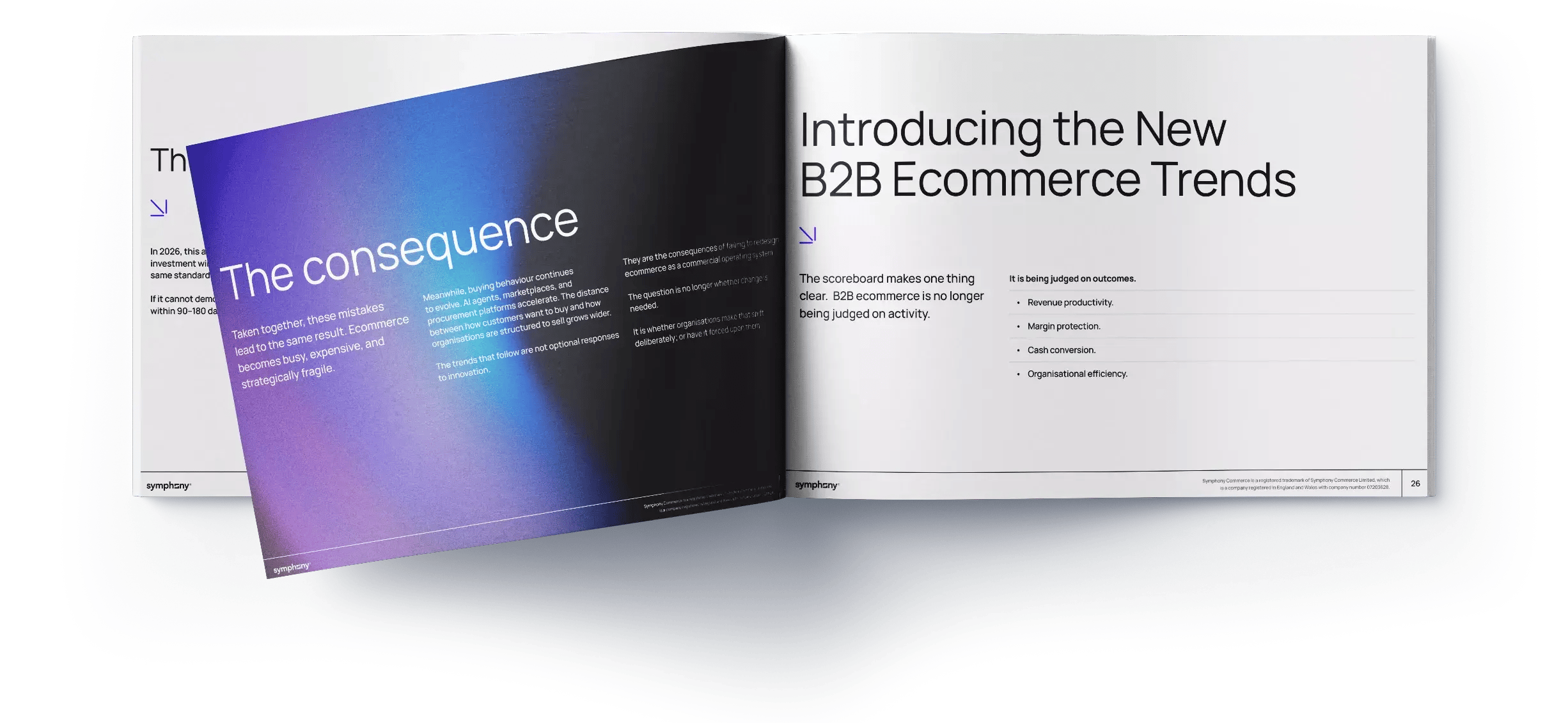
B2B ecommerce is entering a new phase.
For years, digital commerce strategies focused primarily on storefront experience, online catalogues, and self-service ordering. Those capabilities remain essential, but they no longer define competitive advantage.
What is changing is the role ecommerce plays inside the organisation.
Increasingly, ecommerce platforms are becoming the commercial operating system of the business. They influence how customers discover suppliers, how pricing decisions are made, how payments are processed, and how teams across sales, finance, and operations collaborate.
The companies pulling ahead are not simply improving their websites. They are redesigning the commercial infrastructure that sits behind them.
According to Digital Commerce 360, B2B ecommerce sales in the United States exceeded $2.1 trillion in 2023, highlighting the scale and momentum of digital trade.
This shift is explored in our leadership whitepaper B2B Ecommerce Trends in 2026 and Beyond, written by Symphony Commerce CEO Matt Smith.
The report examines the structural changes reshaping how organisations buy, sell, and operate in a digital-first environment.
Key Takeaways: B2B Ecommerce Trends for 2026
- B2B ecommerce is becoming the commercial operating system of the business, connecting pricing, payments, procurement, and customer experience.
- AI-assisted purchasing and agentic buying are beginning to influence how suppliers are discovered and evaluated.
- High-value B2B deals are increasingly happening online, with digital platforms supporting complex sales processes.
- Marketplaces continue to grow as discovery channels, but businesses must balance marketplace reach with direct customer relationships.
- Composable commerce architectures allow organisations to evolve their technology stack faster, supporting complex B2B requirements.
- Embedded payments and fintech solutions are transforming payment infrastructure, improving both customer experience and cash flow.
- Procurement system integrations are reshaping the buying journey, moving purchasing into buyer-controlled environments.
- Trust signals, security, and compliance visibility are becoming key decision factors in digital supplier evaluation.
- Sustainability data is increasingly integrated into procurement workflows, influencing supplier selection.
- Automation increases the value of human expertise, with sales teams focusing on complex deals and strategic relationships.
Below is an executive overview of the top B2B ecommerce trends shaping digital commerce in 2026 and beyond.
Your Guide to B2B Ecommerce Trends in 2026 and Beyond
What Are B2B Ecommerce Trends?
B2B ecommerce trends refer to the technological, operational, and commercial shifts shaping how businesses buy and sell products online. These developments include AI-assisted purchasing, digital-first sales processes, marketplace expansion, composable commerce architecture, embedded payments, and procurement-integrated buying experiences.
Together, these changes are transforming ecommerce from a simple ordering channel into the commercial infrastructure that powers modern B2B trade.
The Top 10 B2B Ecommerce Trends at a Glance
|
Trend |
What It Means for B2B Businesses |
|
Agentic Buying |
AI systems increasingly influence supplier selection and purchasing decisions |
|
Digital-First Six-Figure Deals |
High-value B2B transactions are increasingly initiated and completed online |
|
Marketplaces as Power Channels |
B2B marketplaces are becoming critical discovery channels for buyers |
|
Composable Ecommerce |
Flexible, modular commerce architectures enable faster innovation |
|
Pricing and CPQ Modernisation |
Advanced pricing systems help organisations manage complex deal structures |
|
Embedded Payments |
Integrated payment systems accelerate cash flow and improve buyer experience |
|
Procurement-Native Buying |
Buyers increasingly purchase through procurement platforms rather than supplier websites |
|
Trust Architecture |
Security, compliance, and reliability signals influence supplier selection |
|
Sustainability in Commerce |
Environmental and regulatory data are increasingly integrated into purchasing decisions |
|
The Human Premium |
Automation increases the value of expert sales and advisory relationships |
These developments are not distant predictions.
They are already reshaping how B2B organisations compete, win customers, and scale their digital commerce operations.
Jump to a Trend
Your 80-Page Strategic Guide to Ecommerce Migration
Full List and Insights: The Top 10 B2B Ecommerce Trends Shaping Digital Commerce
1. Agentic Buying: When Your Next Customer Is an AI
One of the most significant developments in digital commerce is the rise of agentic buying.
Increasingly, purchasing decisions are supported by intelligent systems that analyse supplier data, compare pricing, evaluate availability, and assess trust signals before presenting options to buyers.
In practice, this means ecommerce platforms must communicate effectively with both humans and machines.
Structured product data, pricing transparency, and API connectivity are becoming essential as procurement technologies evolve.
Research from McKinsey highlights how artificial intelligence is already reshaping procurement processes by enabling organisations to analyse supplier data, evaluate purchasing options, and automate parts of the decision-making process.
Businesses that optimise their digital commerce infrastructure for both human and machine decision making will gain a growing competitive advantage.
2. Digital-First Six-Figure Deals
High-value B2B transactions are increasingly happening online.
Deals worth tens or even hundreds of thousands of pounds now begin, progress, and sometimes conclude through ecommerce platforms.
This does not eliminate the role of sales teams.
Instead, sales professionals increasingly focus on relationship building, negotiation, and strategic deal support, while ecommerce platforms manage configuration, quoting, and ordering workflows.
According to McKinsey's Global B2B Pulse Survey, more than 70 percent of B2B decision makers now prefer digital self-service or remote interactions over traditional in-person sales engagement.
The most successful organisations integrate ecommerce and sales into a single commercial engine rather than treating them as competing channels.
3. Ecommerce Marketplaces as B2B Power Channels
Marketplaces have become one of the most powerful discovery engines in B2B commerce.
Platforms such as Amazon Business and industry-specific marketplaces allow buyers to compare suppliers quickly and transparently.
For sellers, marketplaces can unlock rapid demand generation and access to new customers.
However, they also introduce risks including margin pressure, increased competition, and reduced ownership of the customer relationship.
Research from Digital Commerce 360 shows that B2B marketplaces continue to expand rapidly as buyers increasingly begin supplier discovery on marketplace platforms.
Leading organisations treat marketplaces as strategic demand channels while continuing to invest in strong direct ecommerce capabilities.
4. Composable Ecommerce Becomes an ROI Requirement
Composable commerce is increasingly becoming the architecture of choice for modern B2B organisations.
Instead of relying on a single monolithic platform, businesses assemble a flexible ecosystem of specialised technologies that work together.
This approach allows organisations to evolve their digital commerce capabilities without rebuilding their entire technology stack.
Research from Gartner highlights that composable business architectures allow organisations to adapt faster to changing market conditions and deliver new digital capabilities more quickly.
As B2B commerce becomes more complex, flexibility is no longer just a technical preference. It is becoming a commercial requirement.
5. Pricing and CPQ Modernisation
Pricing remains one of the least digitised areas of many B2B organisations.
Manual quoting processes, spreadsheets, and disconnected pricing systems are still widely used.
As ecommerce expands, this approach becomes increasingly difficult to manage.
Modern CPQ systems allow organisations to manage complex pricing rules, customer-specific agreements, and product configurations in a structured way.
Research from Bain & Company shows that companies implementing advanced pricing strategies can increase margins by 2 to 7 percent without reducing sales volume.
In modern digital commerce environments, the quote itself becomes the product, allowing deals to move faster while maintaining pricing control.
6. Embedded Payments and B2B Fintech
Payments are evolving from a back-office function into a strategic element of digital commerce.
Embedded payment infrastructure allows organisations to integrate payment options directly into the purchasing experience rather than relying solely on manual invoicing and offline payment processing.
This shift improves customer convenience while also simplifying financial operations such as reconciliation and credit management.
Research from PYMNTS shows that more than 70 percent of B2B buyers expect digital payment options when purchasing online, including card payments and integrated digital payment methods.
For many organisations, payment infrastructure is becoming just as important as the ecommerce platform itself.
7. Procurement-Native Buying Experiences
B2B purchasing increasingly happens inside procurement systems rather than supplier websites.
Large organisations rely on procurement platforms to manage purchasing approvals, supplier comparisons, and compliance requirements.
These systems often integrate directly with supplier ecommerce platforms through punchout catalogues and API connections.
Research from Ardent Partners highlights that procurement teams increasingly prioritise digital supplier integrations and automated purchasing workflows.
As procurement systems become more sophisticated, ecommerce platforms must integrate seamlessly into buyer-controlled purchasing environments.
8. Trust Architecture as a Deal Accelerator
Trust signals are becoming a decisive factor in supplier selection.
Buyers increasingly evaluate suppliers based on visible indicators such as security certifications, compliance standards, and operational transparency.
These signals reduce uncertainty in digital purchasing environments and help buyers evaluate suppliers more quickly.
Research from PwC's Global Consumer Insights Survey shows that 87 percent of buyers consider trust and transparency important factors when choosing suppliers.
Businesses that make trust signals visible within their ecommerce experience can reduce friction and accelerate purchasing decisions.
9. Sustainability and Compliance in Commerce Workflows
Sustainability is moving from corporate messaging into operational purchasing decisions.
Many organisations now evaluate suppliers based on environmental impact, regulatory compliance, and supply chain transparency.
As a result, sustainability data increasingly needs to appear directly within digital purchasing workflows.
Research from Deloitte highlights how supply chain sustainability has become a major strategic priority for organisations evaluating supplier relationships.
Digital commerce platforms therefore need to surface sustainability and compliance data alongside pricing and product information.
10. The Return of the Human Premium
Automation is expanding rapidly across digital commerce.
Routine transactions, pricing calculations, and ordering processes are increasingly managed by technology.
However, this shift does not eliminate the need for human expertise.
Instead, it increases its value.
Sales teams and commercial specialists increasingly focus on complex deals, strategic relationships, and advisory roles where expertise matters most.
Research published in Harvard Business Review shows that organisations combining strong digital channels with expert human engagement achieve stronger customer loyalty and higher deal value.
The future of B2B commerce is not purely digital. It is a balance between automation and expertise.
Ecommerce options structured to deliver maximum value and flexibility
How B2B Ecommerce Strategy Is Changing
The shift toward digital commerce is forcing organisations to rethink how their commercial operations are structured.
Historically, ecommerce was often treated as a separate channel managed by marketing or digital teams. Today it is increasingly becoming a cross-functional system connecting sales, finance, operations, and procurement.
As more purchasing activity moves online, ecommerce platforms must support a broader set of commercial capabilities including pricing management, procurement integrations, payment processing, and operational automation.
This is why many organisations are beginning to view ecommerce not as a website, but as the commercial operating system of the business.
In practice, this means ecommerce infrastructure must now support:
- complex pricing and quoting workflows
- integration with procurement systems
- embedded payment capabilities
- structured product and pricing data
- automation across operational processes
Organisations that treat ecommerce as a strategic commercial platform rather than simply a digital storefront are better positioned to adapt as B2B buying behaviour continues to evolve.
How to Prepare for the Future of B2B Ecommerce
Understanding the trends shaping digital commerce is only the first step.
The organisations leading in B2B ecommerce are actively modernising their commerce infrastructure to support the next generation of buying behaviour.
Common priorities include:
Modernising pricing and quoting
Advanced CPQ systems allow businesses to manage complex pricing structures while accelerating deal velocity and reducing manual quoting processes.
Integrating ecommerce with procurement systems
Connecting ecommerce platforms to buyer procurement environments ensures suppliers remain accessible within structured purchasing workflows.
Improving payment infrastructure
Embedded payment capabilities help organisations accelerate cash flow while simplifying financial operations.
Investing in flexible commerce architecture
Composable commerce systems allow organisations to evolve their technology stack without rebuilding their entire platform.
Strengthening trust and compliance visibility
Clear signals around security, compliance, and operational reliability help buyers evaluate suppliers with confidence.
Together, these initiatives help organisations move beyond basic ecommerce functionality toward a fully integrated commercial infrastructure.
Building Commerce Infrastructure for the Next Phase of B2B
As digital purchasing continues to evolve, organisations need commerce platforms capable of supporting complex commercial environments.
This includes capabilities such as flexible pricing management, integrated payments, automation across operational workflows, and seamless integrations with procurement and enterprise systems.
Platforms designed around composable architecture and modular capabilities make it easier for organisations to adapt their commerce infrastructure as new technologies and buying behaviours emerge.
Ultimately, the organisations that succeed in the next phase of B2B commerce will be those that treat ecommerce not as a channel, but as a strategic system connecting the entire commercial operation.
The Future of B2B Ecommerce
The trends explored in this article illustrate a broader transformation taking place across digital commerce.
B2B ecommerce is no longer simply about online ordering.
It is becoming the infrastructure that connects pricing, payments, procurement, customer relationships, and operational workflows across the entire organisation.
For leadership teams, the question is no longer whether ecommerce matters.
The real question is whether their organisation is building the commercial infrastructure required to compete in the next phase of digital trade.
To explore these trends in greater depth, download the full leadership report written by Symphony Commerce CEO Matt Smith.
B2B Ecommerce Trends in 2026 and Beyond
Download the full trends report right here at Symphony Commerce!
The report explores the ten trends discussed here in greater detail and provides additional strategic insight for CEOs, CROs, CFOs, CTOs, and transformation leaders responsible for shaping the future of digital commerce.
API-first solutions that remove the barriers between innovation and execution
Frequently Asked Questions About B2B Ecommerce Trends
What are the biggest B2B ecommerce trends in 2026?
The most important B2B ecommerce trends in 2026 include AI-assisted purchasing, digital-first high-value transactions, marketplace growth, composable commerce architectures, embedded payments, procurement integrations, trust infrastructure, sustainability transparency, advanced pricing systems, and the growing importance of human expertise alongside automation.
Together, these developments are transforming ecommerce from a digital storefront into the commercial operating system of the business.
How fast is B2B ecommerce growing?
B2B ecommerce continues to grow rapidly as more organisations digitise procurement and purchasing processes.
According to Digital Commerce 360, B2B ecommerce sales in the United States exceeded $2.1 trillion in 2023, demonstrating the scale and momentum of digital trade.
Source: https://www.digitalcommerce360.com/article/b2b-ecommerce-market-us/
Why is B2B ecommerce becoming more important for organisations?
B2B ecommerce platforms are evolving beyond simple online ordering systems.
Modern digital commerce platforms now influence multiple commercial functions including pricing management, procurement workflows, payment processing, customer self-service, and operational automation.
As a result, ecommerce is becoming a central system connecting sales, finance, operations, and customer experience.
What is agentic buying in B2B ecommerce?
Agentic buying refers to purchasing decisions supported or partially executed by intelligent software systems.
These systems analyse supplier data, compare pricing, evaluate availability, and recommend purchasing options to procurement teams.
As procurement technology evolves, ecommerce platforms must increasingly support machine-readable product data and automated supplier evaluation.
How is AI changing B2B ecommerce?
Artificial intelligence is increasingly used to support supplier discovery, automate procurement analysis, improve demand forecasting, and personalise digital purchasing experiences.
Research from McKinsey highlights how AI is already being used to optimise procurement and supplier selection processes.
What is composable commerce in B2B ecommerce?
Composable commerce is an architectural approach where businesses build their digital commerce infrastructure from modular components rather than relying on a single monolithic platform.
This approach allows organisations to adapt their commerce systems more quickly as technologies and customer expectations evolve.
More information about composable commerce can be found in Gartner research.
Source: https://www.gartner.com/en/documents/5083331
Why are B2B marketplaces growing so quickly?
Marketplaces simplify supplier discovery and product comparison for buyers.
Instead of researching suppliers individually, buyers can evaluate multiple vendors within a single platform.
This makes marketplaces powerful demand channels, although organisations must also manage margin pressure and maintain strong direct commerce capabilities.
What are embedded payments in B2B ecommerce?
Embedded payments refer to payment capabilities integrated directly into ecommerce platforms.
Instead of relying on manual invoicing processes, customers can complete transactions within the digital buying experience.
Research from PYMNTS shows that over 70 percent of B2B buyers expect digital payment options when purchasing online.
How are procurement systems changing B2B ecommerce?
Many organisations now purchase goods through procurement platforms rather than directly through supplier websites.
These systems manage supplier comparisons, purchasing approvals, and compliance requirements.
As a result, ecommerce platforms increasingly need to integrate with procurement environments through punchout catalogues and API integrations.
Will ecommerce replace B2B sales teams?
Ecommerce will not replace sales teams.
Instead, it changes how they operate.
Routine transactions increasingly move online, allowing sales professionals to focus on complex deals, strategic relationships, and advisory support where human expertise delivers the most value.
Read The Score - The official Symphony Commerce newsletter
Sources
Digital Commerce 360
https://www.digitalcommerce360.com/article/b2b-ecommerce-market-us/
McKinsey B2B Pulse Survey
https://www.mckinsey.com/capabilities/growth-marketing-and-sales/our-insights/the-new-b2b-growth-equation
McKinsey AI in Procurement
https://www.mckinsey.com/capabilities/operations/our-insights/redefining-procurement-performance-in-the-era-of-agentic-ai
Digital Commerce 360 Marketplaces
https://www.digitalcommerce360.com/2024/10/22/marketplaces-drive-b2b-growth/
Gartner Composable Commerce
https://www.gartner.com/en/documents/5083331
Bain Pricing Research
https://www.bain.com/insights/expanding-profit-margin-through-intelligent-pricing-commercial-excellence-agenda-2025/
PYMNTS B2B Payments
https://www.pymnts.com/checkout-conversion/2025/70-percent-of-shoppers-prioritize-payment-method-when-deciding-where-to-shop/
Ardent Partners Procurement Research
https://ardentpartners.com/ardent-partners-2025-procurement-big-trends-predictions-2/
PwC Global Consumer Insights Survey
https://www.pwc.com/gx/en/industries/consumer-markets/consumer-insights-survey.html
Deloitte Supply Chain Sustainability
https://www.deloitte.com/global/en/issues/climate/transform-csrd-sustainable-supply-chain-transformation.html
Harvard Business Review Human and Digital
https://hbr.org/2024/03/integrating-digital-tools-into-every-stage-of-your-sales-strategy
🔐 Ready to evaluate your current platform? Download the free Decision Kit
💸 Want to see how Symphony Commerce stacks up across plans? Compare our pricing and features
📞 Prefer a conversation? Book a consultation and let’s talk about your ecommerce ambitions.